
Dreaming of capturing the vibrant spirit of Vietnam on paper? Whether you’re a budding artist, a student, or simply someone looking to accurately depict this powerful national symbol, drawing the Vietnam flag with its striking red field and golden star can seem like a precise task. This guide is here to empower you with clear, actionable, step-by-step information, making the process not only achievable but enjoyable. By the end of this comprehensive guide, you’ll know exactly how to draw the Vietnam flag with confidence, understanding its rich symbolism and mastering the essential techniques for a perfect rendition.
Unveiling the Vietnam Flag: Symbolism and Key Proportions
Before you put pencil to paper, understanding the profound meaning and precise proportions of the Vietnam flag will add depth and accuracy to your drawing. This section dives into the heart of what makes the Vietnamese flag a cherished national emblem, providing you with the foundational knowledge to truly honor its design.
The Deep Meanings Behind the Red Field and Golden Star
The national flag of the Socialist Republic of Vietnam, often affectionately called the “golden-starred red banner” (cờ đỏ sao vàng), is a potent symbol of the nation’s history, struggle, and unity. The flag’s design, adopted in its current form in 1955 and used universally after reunification in 1976, is deceptively simple yet laden with deep significance.
The vivid red background represents the revolution, the bloodshed, and the unwavering struggle for independence and freedom that Vietnamese people endured for generations. It symbolizes the sacrifices made and the ultimate success of the nation’s revolutionary path. This powerful color evokes the bravery and determination that characterize the Vietnamese spirit.
Centered on this vibrant red is a bright five-pointed golden star. This golden hue is said to represent the soul of the nation and the color of the Vietnamese people’s skin, reflecting their inherent resilience and unity. Each of the star’s five points holds a specific symbolic meaning, representing the five principal classes that historically composed Vietnam’s political front: intellectuals, farmers, workers, entrepreneurs (or businessmen), and soldiers. Together, they signify the great unity of the Vietnamese people in building and defending their homeland.
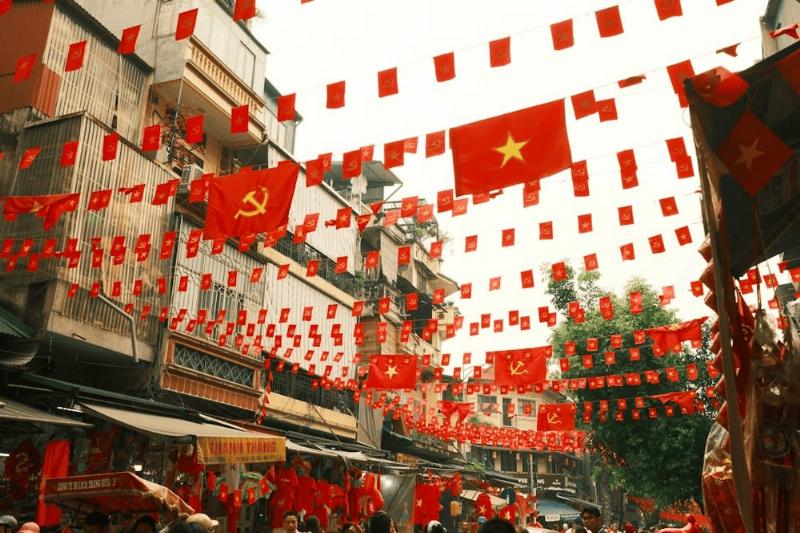
 Vibrant Vietnam flag showcasing red field and golden star, representing revolution and unity.
Mastering the Flag’s Accurate Dimensions (2:3 Ratio)
Accuracy is key when drawing any national flag, and the Vietnam flag is no exception. Understanding its correct proportions is the first step toward a respectful and precise depiction.
The national flag of Vietnam is rectangular in shape, with a clearly defined aspect ratio. Its width (height) is precisely two-thirds (2/3) of its length (width), commonly expressed as a 2:3 ratio. This means if your flag is 30 centimeters long, it should be 20 centimeters high. Adhering to this ratio ensures your flag looks authentic and balanced.
The golden star is positioned perfectly in the center of the red background. One point of the five-pointed star must face directly upwards. While specific regulations on the star’s exact size relative to the flag’s dimensions can be quite technical, a general guideline is that the star should be prominent, occupying a significant portion of the flag’s central area without touching the edges. A common artistic interpretation allows the star to be inscribed within a circle whose diameter is approximately 3/5 of the flag’s height, ensuring it fills the central space harmoniously.
Your Step-by-Step Guide to Drawing the Vietnam Flag
Ready to bring the “golden-starred red banner” to life? This section provides a meticulous, easy-to-follow, step-by-step guide to drawing the Vietnam flag accurately. We’ll break down each stage, from sketching the basic rectangle to perfecting the star and adding color, ensuring you achieve a result you can be proud of. Even if you’re a beginner, these instructions will guide you through every line and shade.
Step 1: Crafting the Perfect Red Rectangle (5 minutes)
The foundation of your Vietnam flag is a precisely proportioned rectangle. This initial step sets the stage for all subsequent elements, so take your time to get it right.
Action: Begin by drawing a clean, horizontal rectangle on your paper.
What to expect: You’ll create the outer boundary of your flag.
Instructions:
- Determine your size: Decide how large you want your flag to be. For instance, if you want your flag to be 15 cm long, then its height must be 10 cm (since 15 cm * 2/3 = 10 cm). Choosing manageable dimensions, like 15×10 cm or 21×14 cm (for A4 paper), is ideal for beginners.
- Draw the base line: Use a ruler and pencil to draw a straight horizontal line for the bottom edge of your flag.
- Draw the vertical sides: From each end of your base line, draw a vertical line upwards, ensuring both are exactly the calculated height (e.g., 10 cm). Make sure these lines are perpendicular to the base.
- Complete the rectangle: Connect the tops of the two vertical lines with another horizontal line to form the top edge of your rectangle. Double-check that all angles are 90 degrees and your proportions (width:length) are 2:3. Lightly sketch these lines; you’ll erase some later.
Step 2: Precisely Locating the Star’s Center (3 minutes)
The golden star must be perfectly centered for an authentic Vietnam flag. This step involves finding the exact midpoint of your rectangle, which will serve as the star’s anchor point.
Action: Identify and mark the exact center of your red rectangle.
What to expect: You’ll have a clear central point where your star will be drawn.
Instructions:
- Draw diagonals: Using your ruler and pencil, lightly draw two diagonal lines, connecting opposite corners of your rectangle.
- Mark the center: The point where these two diagonal lines intersect is the precise center of your flag. Mark this point clearly with a small cross or dot. This is where the center of your golden star will sit.
- Erase diagonals: Once the center is marked, gently erase the diagonal lines. These were merely guides.
Step 3: Constructing the Iconic Five-Pointed Golden Star (10-15 minutes)
Drawing a perfectly symmetrical five-pointed star can be the trickiest part, but with the right method, it’s entirely achievable. We’ll use a compass and protractor method for accuracy.
Action: Draw a symmetrical five-pointed star with one point facing upwards, centered on your marked point.
What to expect: A perfectly formed star ready for coloring.
Instructions:
- Draw a guide circle: Place the compass point on the center you marked in Step 2. Open your compass to a radius that ensures the star will be a significant size but will not touch the edges of the flag. A good starting point is a radius equal to about 1/5 of the flag’s height. Lightly draw a circle. This circle defines the outer points of your star.
- Mark the top point: From the center point, draw a light vertical line straight up until it intersects your guide circle. This intersection is the first (top) point of your star.
- Mark the other points using a protractor: A circle has 360 degrees. For a five-pointed star, each point is 360/5 = 72 degrees apart.
- Place your protractor’s center on the flag’s center point, aligning the 0/180 degree line with the vertical line you just drew.
- From the top point (0 degrees), mark points at 72 degrees, 144 degrees, 216 degrees, and 288 degrees around the circle. These marks, when connected to the center point, will show you the exact locations of the other four points on the circle’s circumference.
- Alternatively, you can mark points at +/- 36 degrees from the top point’s vertical axis for the top two base points, and +/- 108 degrees for the bottom two base points relative to the top point.
- Connect the points: Now, using your ruler and pencil, connect the points you marked on the circle, skipping one point each time.
- Connect Point 1 (top) to Point 3.
- Connect Point 3 to Point 5.
- Connect Point 5 to Point 2.
- Connect Point 2 to Point 4.
- Connect Point 4 back to Point 1.
This method will create a perfect, symmetrical five-pointed star.
- Refine and erase: Once you are satisfied with the star’s shape, gently erase the guide circle and any construction lines inside the star. You should be left with a clear outline of a perfect golden star.
Step 4: Bringing Your Flag to Life with Color (5-10 minutes)
With the outline complete, it’s time to add the iconic colors that give the Vietnam flag its powerful visual identity.
Action: Color the background red and the star yellow.
What to expect: A fully colored, vibrant Vietnam flag.
Instructions:
- Color the background red: Carefully fill the entire rectangular area around the star with a vibrant red. Use crayons, colored pencils, markers, or paint, depending on your chosen medium. Ensure the color is evenly applied without going over the star’s outline. The red should be a bold, clear hue, symbolizing revolution and sacrifice.
- Color the star yellow: Fill the five-pointed star with a bright, clear yellow or gold color. Take care to stay within the lines. The yellow should stand out brilliantly against the red background, representing the nation’s soul and people.
- Final touches: Once the colors are dry (if using paint), you can use a fine-tip black pen or marker to trace the outlines of the flag and the star for a sharper, more defined look, though this is optional.
 A completed hand-drawn and colored Vietnam flag, vibrant red field with bright golden star.
Common Mistakes to Avoid for an Authentic Flag
Drawing a national flag requires attention to detail. Avoiding these common pitfalls will significantly enhance the accuracy and respectfulness of your Vietnam flag rendition.
Mistake #1: Ignoring the 2:3 Proportion
Many aspiring artists simply draw a square or a generic rectangle, which immediately distorts the flag’s authentic appearance. The 2:3 width-to-length ratio is fundamental to the Vietnam flag’s design.
Why it’s a problem: An incorrect rectangle makes the flag look disproportionate and unprofessional. It fails to accurately represent the national symbol.
What to do instead: Always start by establishing the 2:3 ratio. Measure your chosen length and then calculate 2/3 of that length for the height. For example, if the length is 30 cm, the height must be 20 cm. Use a ruler to ensure precise measurements for all four sides.
Mistake #2: An Imperfectly Drawn or Placed Star
A star that is off-center, uneven, or has points that aren’t crisp or pointing upwards detracts from the flag’s integrity. Freehanding a star often results in asymmetry.
Why it’s a problem: The golden star is the central focal point and its symbolism is crucial. An inaccurate star diminishes the flag’s visual impact and meaning.
What to do instead: Invest time in constructing the star geometrically. Use a compass to draw a guide circle and a protractor to mark the five points at 72-degree intervals, as detailed in Step 3. Ensure one point faces directly upwards. Practice drawing the star separately a few times before adding it to your flag.
Mistake #3: Using Incorrect Shades of Red and Yellow
While “red” and “yellow” might seem straightforward, the specific vibrancy and clarity of these colors are important for the Vietnam flag. Using dull, pastel, or overly dark shades can misrepresent the flag’s energetic and hopeful symbolism.
Why it’s a problem: The colors carry deep symbolic weight (revolution, people’s skin color). Incorrect shades dilute this meaning and make the flag appear less authentic.
What to do instead: Opt for bright, clear, and rich hues of red and golden yellow. If using paints, test shades on scrap paper first. If using digital tools, use vibrant color codes. Avoid colors that lean towards orange, brown, or pink.
Essential Tools & Resources for Your Drawing Journey
To ensure your Vietnam flag drawing is as accurate and satisfying as possible, having the right tools is crucial. From traditional art supplies to helpful digital aids, this section outlines everything you’ll need.
Basic Drawing Supplies for Every Artist
Even a simple drawing can benefit from quality basic tools. These are the essentials for any physical drawing of the Vietnam flag:
- Pencil: A good quality graphite pencil (HB or 2B) for sketching light, erasable guide lines. You’ll need it for the initial rectangle and star construction.
- Eraser: A soft, high-quality eraser is indispensable for cleanly removing guide lines without smudging or damaging your paper.
- Ruler: A sturdy, clear ruler (at least 30 cm or 12 inches) is absolutely essential for precise measurements and straight lines. This ensures the 2:3 ratio of the flag and the straight edges of the star.
- Compass: For drawing the perfect guide circle for your star, a compass is highly recommended. It ensures a symmetrical base for the five points.
- Protractor: While not strictly mandatory if you use the geometric arc method for the star, a protractor makes marking the 72-degree angles for the five star points much faster and more accurate.
- Paper: Choose a smooth, medium-weight drawing paper that can handle your chosen coloring medium without bleeding or buckling. Standard printer paper works for pencil/crayons, but heavier paper is better for markers/paint.
- Coloring Mediums:
- Red: Bright, vibrant red.
- Yellow/Gold: Clear, bright yellow or golden hue.
- Options include: colored pencils, crayons, markers (alcohol or water-based), acrylic paints, or watercolors.
Harnessing Digital Tools and Templates
For those who prefer digital art or want to create a perfect template, several digital resources can streamline the process:
- Vector Graphics Software: Programs like Adobe Illustrator, Inkscape (free), or Affinity Designer are excellent for creating precise, scalable vector images of the flag. They allow you to define exact dimensions and angles.
- Raster Graphics Software: Software like Adobe Photoshop, GIMP (free), or Krita (free) can also be used for digital drawing, offering various brushes and fill tools for coloring.
- Online Drawing Tools: Websites like Canva or Sketchpad offer simpler browser-based drawing interfaces that can be helpful for quick digital sketches.
- Printable Templates: A quick search online for “Vietnam flag template printable” can yield outlines that you can print and trace or color in directly. These are great for practice.
Cost of Materials & Budgeting Your Art Supplies
Drawing the Vietnam flag doesn’t have to break the bank. You can create a beautiful rendition with minimal investment, or opt for higher-quality supplies for a more professional finish.
- Budget Option: $5–$15 (what you get)
- A basic set of school-grade pencils, eraser, ruler, and a small pack of crayons or colored pencils.
- Standard printer paper or a basic sketchpad.
- This option is perfect for students, casual drawing, or simply practicing the technique. The tools are functional and readily available.
- Mid-range Option: $20–$50 (what you get)
- Higher quality drawing pencils (e.g., Faber-Castell, Staedtler), a better eraser, a metal ruler, and a reliable compass and protractor set.
- A set of artist-grade colored pencils (e.g., Prismacolor Scholar) or a small set of acrylic/watercolor paints.
- Medium-weight drawing paper (e.g., Canson, Strathmore).
- This range offers improved performance, smoother application, and better durability for tools, suitable for hobbyists looking for a step up.
- Premium Option: $60+ (what you get)
- Professional-grade drawing tools, including an advanced compass, drafting ruler, and a comprehensive set of artist-quality markers or paints (e.g., Copics, Winsor & Newton).
- Specialty art paper designed for specific mediums, offering superior texture and archival quality.
- This is for serious artists or those needing a professional-grade output, perhaps for display or digital reproduction.
Cost-saving tips:
- Use what you have: Before buying new supplies, check your existing stationery.
- Buy in sets: Art supply sets often offer better value than individual items.
- Look for sales: Art stores frequently have discounts, especially during back-to-school or holiday seasons.
- Free digital software: Inkscape, GIMP, and Krita are powerful, free alternatives to paid design software.
Pro Tips from Experience for a Flawless Vietnam Flag
Drawing the Vietnam flag well goes beyond just following steps; it involves a few insider tricks that can elevate your work from good to great. These tips come from experience and will help you achieve a truly flawless result.
-
Tip: Work Lightly First: Always begin your drawing with very light pencil lines, especially for the rectangle and star construction.
- Why it matters: This allows you to easily erase and adjust any errors without leaving indentations or smudges on your paper. Heavy lines are difficult to remove cleanly.
-
Tip: Rotate Your Paper, Not Your Hand (for stars): When drawing the star, if you find it hard to draw consistent lines, rotate your paper as you draw each segment.
- Why it matters: This allows you to always draw lines from a comfortable angle, reducing strain and improving the consistency and straightness of your star’s edges.
-
Tip: Use a Test Swatch for Colors: Before applying color directly to your flag drawing, test your red and yellow on a separate piece of paper.
- Why it matters: This helps you confirm the exact shade and intensity, ensuring they align with the vibrant colors of the actual flag and preventing disappointment with the final look.
-
Tip: Outline with a Fine-Tip Pen (Optional but Recommended): After coloring, consider tracing the outer edges of the flag and the star with a fine-tip black pen or marker.
- Why it matters: This gives your drawing crisp, clean edges and makes the colors pop, adding a professional, finished look to your flag. Wait until your colors are fully dry if using paint.
-
Tip: Utilize Geometric Star Drawing Methods: Resist the urge to freehand the star.
- Why it matters: While quicker, freehand stars are rarely symmetrical. Using a compass and protractor (or other geometric methods) guarantees a balanced, aesthetically pleasing star, which is critical for a national symbol.
-
Tip: Understand the Negative Space: Pay attention to the red areas around the star. They are just as important as the star itself.
- Why it matters: The relationship between the star and the red field contributes to the flag’s overall balance. Ensure the star isn’t too small (lost in the red) or too large (cramped).
Best Time & Timing Considerations
When it comes to drawing the Vietnam flag, “timing” isn’t about seasons or specific dates, but rather about your approach and preparation. Thinking about these aspects can enhance your drawing experience and outcome.
- When to do this: Anytime you feel inspired! There’s no “best season,” but a quiet, focused time of day (morning or evening) can aid concentration. If you’re drawing for a specific event (like a cultural festival or national holiday), plan to start well in advance.
- How far in advance to plan/book: Drawing isn’t “booked,” but “planning” is key. If you’re creating a large, detailed piece or multiple flags, give yourself ample time. For a simple guide like this, an hour or two should suffice, but don’t rush the star.
- How long it takes: For a basic, accurately drawn and colored flag following this guide, expect to spend about 30-60 minutes. This includes time for light sketching, precise measurements, star construction, and careful coloring. More detailed work or larger formats will naturally take longer.
- What to avoid:
- Rushing: Precision is paramount for national flags. Rushing leads to sloppy lines, incorrect proportions, and an uneven star.
- Distractions: Find a quiet space where you won’t be interrupted, allowing you to focus on the intricate details, especially when drawing the star.
- Lack of proper lighting: Good lighting is crucial for seeing your lines clearly and accurately judging colors.
Getting Started & Logistics: Essential Checklist Before You Begin
Before you embark on drawing your Vietnam flag, a quick check of your materials and mental preparation can make all the difference. This checklist ensures you have everything in order for a smooth and successful artistic endeavor.
Before you go (or begin drawing):
- Gather your supplies: Ensure you have your pencil, eraser, ruler, compass, protractor (if using), and chosen coloring mediums (red and yellow).
- Prepare your workspace: Clear a flat, well-lit surface where you can spread out comfortably.
- Reference image (optional): Have a clear image of the Vietnam flag handy for visual reference, especially for color shades.
- Understand the proportions: Mentally (or on a scrap paper) calculate your desired flag dimensions based on the 2:3 ratio.
During your experience:
- Start light, stay light: Remember to use light pencil strokes for all initial outlines and construction lines.
- Measure twice, draw once: Double-check all measurements, especially for the rectangle and star placement.
- Be patient with the star: The star requires the most precision; take your time with its construction.
- Color within the lines: Apply colors carefully to avoid bleeding or going outside the lines.
After/Follow-up:
- Clean up: Erase any remaining pencil guide lines gently after coloring.
- Display proudly: Once dry, your flag is ready to be admired!
- Practice makes perfect: Don’t be discouraged if your first attempt isn’t flawless. Drawing is a skill that improves with practice.
Frequently Asked Questions
Drawing a national flag often brings up specific questions, particularly for those striving for accuracy and meaning. Here are some common inquiries about drawing the Vietnam flag.
Is it difficult to draw the Vietnam flag accurately?
Drawing the Vietnam flag isn’t inherently difficult, but it requires precision, especially for the 2:3 rectangle proportion and the symmetrical five-pointed star. Beginners might find the star challenging freehand, but using a compass and protractor (as outlined in this guide) makes achieving accuracy much simpler. With patience and practice, anyone can draw it well.
What do the colors of the Vietnam flag represent?
The red background of the flag symbolizes revolution, struggle, and the sacrifices made for independence. The bright golden star represents the soul of the nation and the skin color of the Vietnamese people. Its five points stand for the unity of the five main classes in Vietnamese society: intellectuals, farmers, workers, entrepreneurs, and soldiers.
What is the correct proportion for the Vietnam flag?
The Vietnam flag has a width (height) to length (width) ratio of 2:3. This means that for every 2 units of height, there should be 3 units of length. For example, a flag that is 20 cm high should be 30 cm long. Adhering to this proportion is crucial for an authentic depiction.
How big should the star be on the Vietnam flag?
While there are technical specifications, a general guideline for drawing is that the star should be prominently centered and occupy a significant portion of the flag’s vertical space without touching the edges. A common artistic practice suggests the star can be inscribed within a circle whose diameter is approximately 3/5 of the flag’s height, ensuring it is a bold and central element.
What are the best tools for drawing a precise five-pointed star?
For the most precise five-pointed star, a compass and a protractor are your best friends. The compass helps you draw a perfect guide circle, and the protractor allows you to accurately mark the five points at 72-degree intervals (360 degrees / 5 points = 72 degrees). A ruler is then used to connect these points with straight lines, creating a symmetrical star.
Can I draw the Vietnam flag digitally?
Absolutely! Digital tools like vector graphics software (e.g., Adobe Illustrator, Inkscape) or even simple online drawing applications are excellent for drawing the Vietnam flag. They allow for precise control over lines, shapes, and colors, making it easy to define the exact 2:3 ratio and geometrically perfect star. Many digital tools offer shape tools that can simplify creating a five-pointed star.
Conclusion
Drawing the Vietnam flag is a rewarding way to connect with the rich history and deep symbolism of this resilient nation. By following this complete step-by-step guide, you’ve gained the practical skills to accurately capture its iconic red field and golden five-pointed star. From understanding the profound meanings behind its colors to mastering the precise 2:3 proportions and geometrically constructing the star, you now possess all the knowledge and techniques needed for a flawless rendition.
You’ve got this! With your newfound expertise, you are now equipped to draw the Vietnam flag with confidence and pride, whether for an art project, a school assignment, or simply as a personal endeavor. Don’t hesitate to revisit these steps, use the provided tips, and remember that practice makes perfect. Share your beautiful creations and let the powerful symbolism of Vietnam’s national emblem inspire others.